
















Wooden Field View Cameras of the United States:
An Identification Guide
Introduction
From 1870-1930, an explosion in field camera design occurred in the United States. Rival firms patented designs for beds, reversing mechanisms and plate-holders at a breakneck pace. The result is documented here: a database of wood and brass wet-plate and dry-plate field view cameras manufactured in the United States between 1870-1930. Leather-covered hand and stand cameras have not been included; a database of them would have an even greater number of models and variations.
Links to the camera descriptions and photographs are on the left column of each page, organized by view camera manufacturer, followed by accessories, non-view cameras, lenses and shutters.
The cameras pictured on the pages of this website were formerly part of a private collection. This collection was donated to and is now located at:
The University of California, Riverside - California Museum of Photography (UCR-CMP)
3824 Main Street, Riverside, CA 92501, (951) 827-4787, https://artsblock.ucr.edu/Page/research
Take advantage of the ability to see these cameras in person by making an appointment through the above website.
 Photography by Larry S. Pierce
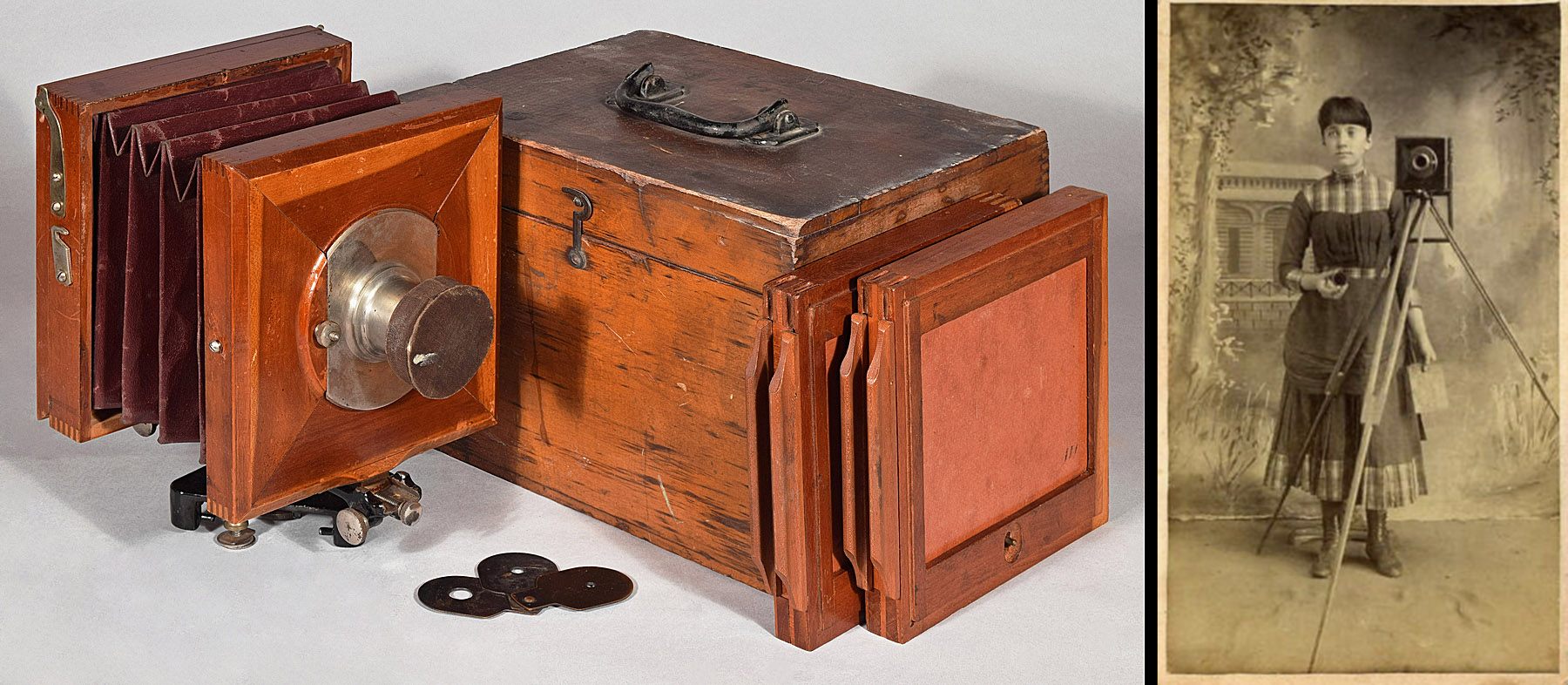
[above:
a Rochester Optical
Co.
American Challenge Swivel Bed Camera
4x5" (1881-1887)]. The lady
at the right knows an innovative design when she sees one.
|
|
Using this website
What
does a "Variation" mean?
About the dates:
Two ways to
browse:
|
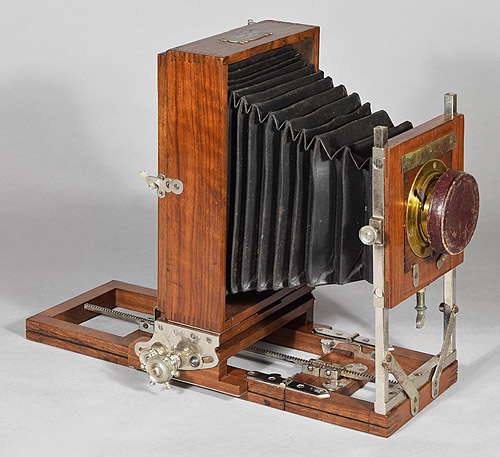
View Camera History and
Technology Series:
The development of wooden view camera designs
during the formative years of photography, 1840 through about 1915.
(coming)
1. To Turn a Camera
- A Survey of Camera Designs 1870-1915 to Enable a Horizontal or
Vertical Photograph Format
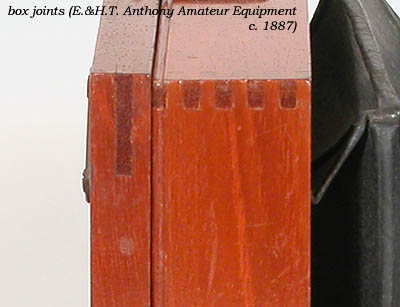 Examples
of View Camera Construction:
a number of trends in
woods used,
finishes,
hardware,
general construction,
construction details, lenses,
carrying cases
can be discerned during this period of view camera variability.
Examples
of View Camera Construction:
a number of trends in
woods used,
finishes,
hardware,
general construction,
construction details, lenses,
carrying cases
can be discerned during this period of view camera variability.
Lenses and Shutters: realizing that the cameras have attached to them a variety of lenses and shutters from the era, separate indexes and thumbnails have been provided for lenses and shutters, as well as information on their appearance in catalogs and patents. For the most part, these images of lenses and shutters leave something to be desired, since they were pulled from existing images that were much larger. Some of them are also out of focus, since the original purpose of the image was to illustrate the camera. While pulling catalog data for lenses or shutters, it seemed logical to pull data for other lenses or shutters advertised from the same company; these entries refer to lenses or shutters for which no photos yet exist, but usually an engraving is available.
 |
An Old Interest - A
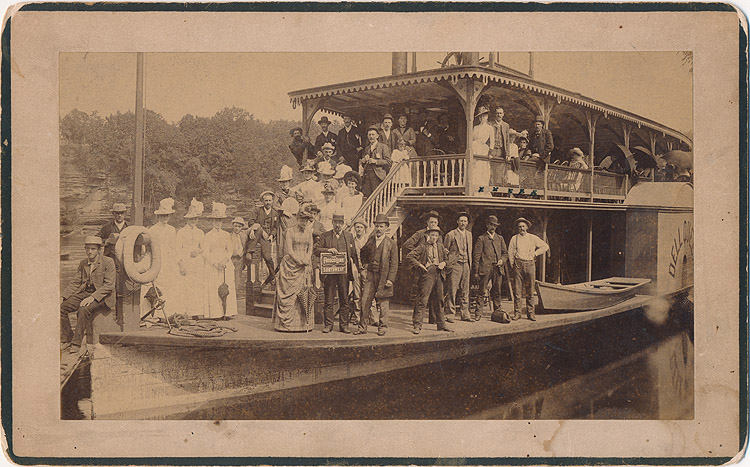
New Posting: Images of H.H. Bennett, Kilbourn City, Wisconsin: Scenic stereographs of the Wisconsin Dells, Devil's Lake, Milwaukee, Chicago, Wisconsin and Minnesota; miscellaneous images of the Bennett family & identified portraits. H.H. Bennett is one of the premier stereograph producers, who worked from the late 1860's through the 1900's, leaving a legacy of more than a thousand views. |
Site Updates ~April 2014 and following:
Updates to catalogs include both an .html version (web page) as well as a .pdf version. The .html version consists of a web page containing many files: one image file for each pair of catalog pages scanned. The .pdf version consists of one file only; this file contains water-marked images of the entire catalog, and requires the Adobe pdf reader or equivalent to view it.
Recent Acquisitions:
◊ Sunart Photo Co. (precursor to Seneca Camera Mfg. Co.)
Vici View and
Vidi View;
◊
Early plate holder box by Scovill Mfg. Co.;
◊ E. & H.T. Anthony & Co. Fairy Camera split in
Fairy View Variation 1 and
Fairy View Variation 2 (Variation 2 is in the elusive Circassian
walnut);
◊ Update on Scovill Mfg. Co.
Ne Plus Ultra (A-D) and
Ne Plus
Ultra (No Letters) with two new examples;
◊ Update on Blair Tourograph & Dry Plate Co./Blair Camera Co.
Utility Variation 1,
Utility Variation 2 and L.M. Prince & Bro.
Prince's Improved Utility with two new examples;
◊ Blair Tourograph & Dry Plate Co./Blair Camera Co. Champion split into
Champion Variation 1 and
Champion Variation 2;
◊ Gundlach-Manhattan Optical Co.
Korona Royal;
◊ Two new examples of Rochester Optical Co.
New
Model, Improved, Variation 2 (thick frame);
◊ Anthony Champion Variation 1 split into
Champion Variation 1A,
Champion Variation 1B and
Champion Variation 1C, and emphasis of its relationship to Anthony's
Amateur Equipment 1-8;
◊
ФЕД (FED) Командирский (Commander) Leica copy c.1930s; no wood, but
brass (1 out of 2 isn't too bad);
◊ New example of
Anthony Novel Variation 2;
◊ Another example of American Optical
Leader Camera (formerly American Optical Waterbury-type Camera);
◊
Unknown Field View Camera No. 14, similar to
Anthony Eureka School Camera and also
Unknown 13;
◊ New example of G. Gennert
Burlington/Nancy Hanks;
◊ New example of Rochester Optical Co.
Ideal
Variation 2;
◊ The Scovill & Adams Co.
Triad Detective Camera;
◊ New example of the Folmer & Schwing Co.
Sky
Scraper, Improved View Camera;
◊ Another example of the Scovill Mfg. Co.
Ne Plus Ultra (A-D) in a stained finish
◊
No. 0 Graphic - a tiny roll film focal plane shutter masterpiece
◊
No. C Ordinary Kodak
◊ New model, kind of:
Canadian Camera & Optical Co. Glencoe View Camera (actually
Rochester Optical Co. Empire State Variation 2)
◊ New example of
American Optical Compact View Variation 1
◊ 7x17" example of
Folmer
& Schwing Banquet Camera
◊ New example of American Optical
Flammang's Patent Revolving Back Camera, Rear Focus, 5x7 with red
Russian leather bellows
◊ Another example of the
Kemper Kombi
◊ A second example of the tiny 3�x4�" American Optical/Scovill
Petite View Camera
◊ An apparently unused example of Scovill Mfg. Co.
Waterbury Variation 1
◊ A
Kodak No. 2 (4x5) and some of its round snapshots
◊ A tricked-out Rochester Optical Co.
Ideal
Variation 1 4x5 outfit with two backs and an Eastman-Walker Roll
Film Holder
◊ Another unique design from Schultze Photo Equipment Co. -
Champion ? View Camera
◊ Seneca View Improved split into three:
Variation 1,
Variation 2, and
Variation 3
09-20-2014
◊
14x17"
Scovill & Adams Co. Acme with fancy spring back
◊
Early? Seneca Camera Mfg. Co. view with rotating lens board
◊
E. & H.T. Anthony Fairy View - in Circassion walnut
◊
Sunart
Vidi View Camera
◊
Gundlach-Manhattan Opt. Co.
Wizard Variation 4 View
◊
Tiny 4�x6�"
E.
& H.T. Anthony Victor in original case
◊ Yet
another variation of the Rochester Opt. Co. New Model -
New
Model Variation 1.3 transitional between
Variation 1 and
Variation 1.5, which itself is transitional between
Variation 1 and
Variation 2, and earlier than
Variation
3 and
Variation 4
◊
Another example of the
Imperial View
◊ A
Putnam Marvel Vertical 4x5", a new example of a Scovill Mfg. Co.
Favorite sold as a Putnam Marvel
◊
Another example of the
American Optical Co. Star View in 5x7"
◊
Another
William T. Gregg English-style View Camera (not from England but
from New York City)
◊ A
second example of the rare Rochester Opt. Co. (or William H. Walker &
Co.)
American Challenge Wood Base 5x8" Camera of 1883
◊ The
American Optical Tourist Pocket Camera was placed in a canvas bag,
as illustrated and stated in advertisements
◊ Comparison, timeline and breakdown study of the
Scovill Acme (Back Focus Cone) View Camera and the almost identical
but later
American Optical Landscape View Camera.
◊ Two
examples of what probably is the
American Optical Landscape View Camera, formerly called Unknown
Scovill View Camera.
◊ Eastman
Kodak Co. No. 1 View with its canvas case in near mint condition.
2015
◊
Folding Kodak No. 4 Improved (B&L Iris Diaphragm Shutter).
◊
Gundlach-Manhattan Optical Co. Korona Royal Series VI.
◊
Blair Camera Co. Champion Variation 1 in original canvas case.
◊ A second example of
Scovill
Ne Plus Ultra (No Letters), with original wooden case.
◊ A second example of
Century Camera Co. Century View No. 2 with original canvas case.
◊ Another example of
Rochester Optical Co. Universal View Variation 2 with original short
form canvas case.
◊ A 5x8" version of
E. &
H.T. Anthony & Co. N.P.A. Variation 3 was added to the 8x10" version
already there.
◊ Another 4x5" example of
Rochester Optical Co. New Model Variation 1 (Beveled Bed) - this one
has a rounded-end metal label on the front.
◊ A 4�x6�"
E. &
H.T. Anthony & Co. N.P.A. Variation 2 was added to the 8x10" version
already there.
◊ A rare
Scovill & Adams Knack Detective Camera.
◊
American Optical Co. Dry Plate Equipment (No. 1-8) Outfit No. 4 with
original wooden case.
◊
American Optical Co. Universal Safety Shutter.
◊ The super-rare and expensive
E. &
H.T. Anthony & Co. Bicycle Camera.
◊
Conley Camera Co. No. 1 Conley View Camera with original
canvas-covered case.
◊ A new type of Schultze Mfg. Co. view camera re-sale: an
E. & H.T. Anthony Champion Variation 1B with a Schultze metal label on
it.
◊ Another instance of the
Blair
Camera Co. Unknown No. 3 - there are two of them now (one single
swing and one double swing), and why does it not match anything in Blair
catalogs?
◊ An early
Rochester Optical Co. New Model Stereo having beveled base rails
like the
New
Model Variation 1.
◊ A second example of a
Folmer
& Schwing Div., EKC 7x17" Banquet Camera - this one with a Folmer &
Schwing film holder and the original Folmer & Schwing canvas case.
◊ c.1937
Folmer-Graflex Pre-Anniversary Speed Graphic in original small-form
leather case.
◊
Manhattan Optical Co. Long Focus Wide Angle Wizard.
◊ 11x14
Blair Combination RB Variation 1.
◊
Scovill Ne Plus Ultra (A-E) No. C - an ebonized 5x8 including a
single-lens lens board for normal mono photos and also a two-lens lens
board for stereo pairs, with wooden case.
◊ Re-organization of the confusing group of camera models advertised as
Anthony Amateur Equipment (No. 1-8B), separating them into
Variation 1 (cameras having non-folding beds) and
Variation 2 (cameras having folding beds), including tables to
clarify the models in 1882, 1885 and 1887-89. Addition of a
c.1882 Outfit No. 5.
◊ Another
Scovill Dry Plate Outfit (No. A-D) with case and American
Optical/Scovill drop shutter, the exact combination seen in another Dry
Plate Outfit example.
◊
Century Long Focus Grand, a leather-covered box with a full view
camera inside.
◊
Early Seneca View Improved Variation 1. Had to re-number the
variations to make room for this unanticipated early variation.
◊
Early Seneca Camera City Variation 1. Seen in 1907 catalog.
Now all Seneca view cameras have been seen in the early hardware style
that has the forward-back swing thumbscrew in a slot halfway up the side
of the camera.
◊ Yet another
American Optical Leader, this time having its ground glass hinged at
the bottom. This makes the Leader almost as common as the
Waterbury, the cheaper Scovill product that it resembles.
◊ Rare scientific camera:
American Optical Walmsley Photomicrographic Camera.
◊ Added a period canvas case to the
Scovill Pocket Bicycle Camera - a canvas bag was advertised to have
come with each camera.
◊ 11-20-2015:
Flandreau 5x7 size added to the 4x5 size already shown.
◊ 12-02-2015: Combining of Scovill thumbnails and American Optical
thumbnails into the
Scovill & American Optical thumbnail page. The new page is
organized into tables of general design and, within tables, organized
into approximately chronological order.
2016
◊
06-20-2016: Expanded description of American Optical 1871 View Camera
Boxes into three models:
View Camera Boxes, Number 1 (Model #1-7),
View
Camera Boxes, No Number (Model #21-28, later #51-58), and
View
Camera Boxes No. 2 (Model #40-50 & #130). This was
precipitated by the identification of an American Optical wet plate
camera that is likely Model #42, photos of which are shown under the
View
Camera Boxes No. 2 (Model #40-50 & #130) page.
◊ 07-06-2016: Found a
Rochester Optical Co. New Model Improved Variation 1.5 having
cam-type ground glass frame clasps. This increases the number of
R.O.C. cameras having cams - it is probable that all models will
eventually be found to have a cam variation, although they are rarely
seen.
◊ 07-07-2016: Found a
Rochester Optical Co. Peerless Variation 1 having the cam-type
ground glass frame clasps not seen before. Now the more common
swivel-clip type of Peerless has to be Variation 2. And this camera is
8x10, another "largest they made" find.
◊ 07-09-2016: A Scovill
Early Waterbury Variation 1A having quarter-sawn sycamore like other
early types such as the
Scovill's New York View.
◊ 07-30-2016: An 8x10
E.
& H.T. Anthony & Co. Victor Variation 1 - the largest they made.
Now the page features photos of 4�x6�,
5x8, 6�x8�
and 8x10.
◊ 08-05-2016: An example of
E. & H.T. Anthony & Co. Long Bellows Clifton, with all of its
extensions - long bellows indeed.
◊ 08-07-2016: Rare J.A. Anderson & Company camera, name not certain, but
probably one of these:
Anderson's View Camera Box/Anderson's Compact Folding View Camera.
◊ 09-01-2016: New hybrid-looking Blair Reversible Back Improved;
Reorganization of Reversible Back Improved into four variations:
Variation 1,
Variation 2,
Variation 3 and
Variation 4.
◊ 10-12-2016: An 8x10"
American Optical Star, complete with track extension.
◊ 10-18-2016: Finally, a
Rochester Ideal Variation 2 having the center-pivot-type swing as
shown in catalog engravings, rather than bottom-type swing, also shown
but apparently much more common.
◊ 10-30-2016: No trick, but a treat: a mint condition
Blair
Reversible Back Camera in its original near mint condition canvas
case.
◊ 11-06-2016: Split American Optical Waterbury-Type in two variations:
American Optical Waterbury-Type Camera Variation 1 (ground glass frame
hinges on the bottom) and
American Optical Waterbury-Type Camera Variation 2 (ground glass frame
hinges on the side).
2017
◊ 01-21-2017: The big bonanza of empty
carrying cases - 7 wooden cases purchased from the same eBay seller.
They are matched with the following cameras:
Carrying Case No. 1) wooden case manufactured by E. &
H.T. Anthony & Co., as indicated by its box-joint edges, and its brass
end retainers for the leather handle (now missing except underneath the
brass hardware) - added to a 5x8"
Anthony Champion Variation 3 (temporary name; the Anthony Champion
variations are in a state of flux as the variations and their time
periods of manufacture are re-examined); the camera is stamped with the
"G.O.Co." logo of the Greenpoint Optical Co., a subsidiary of E. & H.T.
Anthony & Co. The camera fits as if the case were original to the
camera.
Carrying Case No. 2) wooden case manufactured by E. &
H.T. Anthony & Co., as indicated by its box-joint edges, and its brass
end retainers for the leather handle (now missing except underneath the
brass hardware) - added to a 5x8"
American Optical Philadelphia Stereo View Camera. The camera
and its holder are a perfect fit, despite being the wrong manufacturer.
Carrying Case No. 3) wooden case manufactured by E. &
H.T. Anthony & Co., as indicated by its box-joint edges, and its brass
end retainers for the leather handle (now missing and replaced by a
woven cotton handle) - added to a 4x5"
Anthony Amateur
Equipment or
Amateur
Outfit (#'s 1-8B)
Variation 1 Ebonized (non-folding bed).
Carrying Case No. 4)
wooden case of unknown manufacturer; the case has two early features: 1)
mechanically-cut dovetail jointed edges (rather than box jointed) and a
spring-loaded clip to secure the top (rather than a rotating hook) -
added to a 4x5"
American Optical View Camera Boxes Transitional to Improved View Camera
Boxes/Cone View Camera, a hard size and model to fit into a case
because of its unusually great height relative to its width.
Carrying Case No. 5) wooden case manufactured by
Rochester Optical Co. (and so stamped on top) - added to a 4x5"
Anthony Champion Variation 1C (temporary name; the Anthony Champion
variations are in a state of flux as the variations and their time
periods of manufacture are re-examined)
Carrying Case No. 6) wooden case by an unknown
manufacturer - added to a
4x5" Scovill Ne Plus Ultra Rigid Platform (A-E) No. A Stained Finish.
◊ 05-25-2017: A 2nd example of Schultze Early View Camera in 5x8" size
August, 2017:
The HTML editor that I was using had a glitch, which caused the content
to disappear on every page of the 1st back-up of this web site. To
reconstitute the site required copying the content back onto new pages.
In the process, font sizes and colors have been somewhat scrambled.
Also, odd characters were sometimes inserted before the ¼ and ½
characters. Over time, I will be able to standardize the fonts as before, but
meanwhile, ignore the inconsistency.
◊ 05-14-2017: A 5x8" version of a Schultze
Photo Equipment Co. Early View Camera,
which has the unusual pass-through-type of plate holder insertion.
◊ 05-14-2017: An unusual and rare type of a
Scovill Mfg. Co."76" or "Centennial
Camera. Until now, all examples of the "76" had a similar
appearance, with wood, finish and hardware indicative of being made by
the American Optical factory of Scovill. This camera is different
in wood type, finish type, hardware treatment and even size, meaning
probably that it was made in a different factory, perhaps Scovill's New
Haven, CT factory, formerly the Peck factory.
◊ 07-01-2017: A American Optical View
Camera Boxes, Number 1 (Best) (Model No.'s 1-7) in 11x14 (wet plate
field camera!!!)! size that is actually stamped "1st Quality".
◊ 10-08-2017: A detailed look at the examples of all models of the Waterbury Camera,
including a table of characteristics and measurements:
Scovill Waterbury Variation 1,
Scovill Waterbury Variation 2,
Scovill Waterbury Variation 1A,
American Optical Waterbury-Type Variation 1,
American Optical Waterbury-Type Variation 2
- a look at an example of Scovill-American Optical dichotomy of quality.
◊ 10-08-2017: Another example of Scovill-American Optical dichotomy, The
76 Camera: The 76 Camera Variation 1 (catalog
version), The 76 Camera
Variation 2 (Wet Plate Version), and
The 76 Camera Variation 3 (Scovill Version).
◊ 10-15-2017: Eastman-Walker roll holders organized (finally), yielding
an amazing 11 variations, Eastman-Walker Roll Film Holder:
Var. 1,
Var. 2,
Var. 3,
Var. 4,
Var. 5,
Var. 5.5,
Var. 6,
Var. 6.9,
Var. 7,
Var. 8, and
Var. 9. To my
surprise, there were only a few duplicate examples, rivaling Blair
cameras for having many changes and improvements over a relatively short
period of time.
◊ 10-15-2017: Added a period bicycle clamp to the
Ne Plus Ultra Bicyclists'
Photo-Outfit. Now, if only it were attached to an "Ordinary"
or high wheel bicycle...
◊ 11-03-2017: An Anthony Novel Camera,
Novel View Camera Variation 1.5, that does not rotate its
bellows, as do all other dozen or so Novels and Novelettes. Just
when you thought you knew something, a camera comes along to refute your
knowledge.
◊ 2017-Nov through 2018-Mar: many newly taken photographs, especially
AO/Scovill and Anthony. The original photos were taken with a
warm-colored ambient light that tainted the photos The
replacements were taken with no ambient light, so colors are correct.
◊ 11-15-2017: Anthony Champion variations organized via a chart of
features and differences with illustrative thumbnails, see:
Champion Var. 1A,
Champion Var. 1B,
Champion Var. 1C,
Champion Var. 2,
Champion Var. 3, and
Champion Var. 4.
◊ 11-15-2017: Likewise, Anthony NPA variations organized along parallel
lines to the Champions: NPA Brass
Guides, NPA Var. 1A,
NPA Var. 1B, no NPA 1c (solid bed) as
yet so no web page for it, NPA Var. 2,
NPA Var. 3, and
NPA Var. 4.
◊ 12-29-2017: AO/Scovill Acme and Landscape re-organized into four
variations: 1) Acme Variation 1, 2)
Acme Variation 2, 3)
Acme Variation 3, and 4)
Landscape View.
2018
◊ 03-04-2018: Re-organization of Blair
Cincinnati RB Improved variations, and addition of Variation 4, known
from 1893 catalog, but unknown in the flesh. Now Cincinnati RB
Improved Variation 1,
Variation 2,
Variation 3 and
Variation 4. Unimproved type
still unknown.
◊ 03-04-2018: More info from 1886 and 1893 catalogs on Blair Reversible Back
variations. Now 5 Variations:
The Standard Reversible Back (not improved), RB
Improved Var.1, RB Improved Var.2,
RB Improved Var. 3 and
RB Improved Var. 4. The
Standard Reversible Back Camera has two examples, one single swing and
one double swing, that were previously known as Blair Unknown No. 3.
They appeared to be Blair cameras from their hardware, but were not
observed to be described in catalogs until found in the
1886 Blair catalog,
p.10.
◊ 03-17-2018: The Blair Perfect Reversible
Back Camera, previously known from a mention of its name only in an
ad in a Photography Annual, was found completely described in the
Blair 1886 Catalog,
pp. 8-9. The camera that is an example of the Perfect RB
Camera, was previously guessed to be a precursor of the Cincinnati RB
Improved series of variations. This means that the Cincinnati RB
(not improved) is still completely unknown either as a catalog offering
or as an example.
◊ 03-18-2018 & ff: Many newly purchased catalogs scanned:
Blair 1896,
ROC Premier Flyer c.1892,
Blair Hand Cameras
Jul 1893,
Blair Full 1893,
Blair 1886,
Putnam
Detective Camera c.1890,
Blair Hawk-eyes c.1902,
Blair Hawk-eyes c.1904,
Anthony May 1883,
Sunart Photo Co. 1898,
Sunart Photo Co. 1899,
Seneca Camera Mfg.
Co. 1905,
Premo Cameras
c.1904,
ROC Modern
Photography with Explanation of the Apparatus pamphlet c.1891,
ROC Premo Camera 1896,
Scovill & Adams
Catalog January 1891,
The Kamaret
Blair Camera Co. brochure.
◊ 04-15-2018: Tentative identification of
Unknown Field Camera No.6. A number of features of this camera
point to Blair Camera Co. as the manufacturer. It's resemblance to
the Cincinnati RB Improved View Camera
Variation 1 indicates that it may be the elusive
Cincinnati RB View (not improved).
If you have any information about the Cincinnati RB View (not improved),
please contact me at the email at the bottom of this page..
◊ 04-20-2018: More catalogs scanned:
A.B. Paine
(Scovill, Anthony, Rochester, Eastman and others) 1889,
The Montauk Camera '99
G. Gennert,
Korona Cameras
1899 Gundlach Opt. Co.,
G.Gennert Jan. 1, 1895
complete catalog.
◊ 05-1-2018: From information in the 1895 Gennert catalog just above,
split of the Gennert Burlington
Camera and the Gennert Nancy
Hanks Camera, and the addition of another camera related to those,
the Gennert Extra Quality View
Camera.
◊ 05-2-2018: More catalogs scanned:
c.1893 ROC
Premier Regular & Folding booklet,
c. June
1892 Scovill & Adams full catalog,
1921 Graflex &
Graphic Cameras,
120pps of a huge c.1908
Ralph J. Golsen catalog,
2019
◊ 12-26-2019: A rare 3¼x4¼ Rochester Optical Co. New Model Variation 3 - this one
with tripod, case and accessories.
◊ 12-27-2019: Another example (:P1115) of a 5x8"
Rochester Optical Co. New Model Improved Variation 1 (Thin
Frame) with case and plate holders.
2020
◊ 01-27-2020: Added a web page for common
Thornton-Pickard Lens-Mounted
Roller Blind Shutters.
◊ 01-27-2020: Split Eastman View No. 1 into Eastman
Kodak Co. Eastman View No. 1 Variation 1 and
Eastman View No. 1 Variation 2.
◊ 01-28-2020: Split Scovill's Safety Shutter into two variations:
Scovill Mfg. Co. Scovill's Safety Shutter
Variation 1 and
Scovill's Safety Shutter Variation 2.
◊ 01-28-2020: Another example of the
G.Gennert Brighton View Camera.
◊ 01-28-2020: Added the Scovill Mfg. Co. Flammang's Patent
Revolving Back Camera, Back Focus Variation 3 (rack and pinion focus).
◊ 01-28-2020: Added Counterfeit
Scovill Mfg. Co. Flammang's Revolving Back Camera, Back Focus Variation 3 and
re-organized the Flammang's Revolving cameras into Variations 1, 2, 2.2,
3 and counterfeit.
◊ 01-28-2020: Added Blair Camera Co. Cincinnati
Reversible Back Improved Variation 2.5, and concurrently had to
re-organize all the variations of this model.
◊ 01-28-2020: Added Eastman Kodak
Co. The Ordinary Kodak No. B.
◊ 01-29-2020: Added E.&H.T. Anthony Prepared Albumen Paper, 4x5,
unopened box of two dozen.
◊ 01-30-2020: Added another example (LP1195) of the
Blair English Compact Camera Reversible
Back.
◊ 02-02-2020: Added an example of a Blair
English Reversible Back Camera having an installed Eastman-Walker
Roll Holder.
◊ 02-04-2020: Added three more examples of the
E.&H.T. Anthony & Co.
Universal Finder.
◊ 02-05-2020: Added the new variation:
Rochester Optical Co. The Ideal Camera Variation 1.7, and
re-organized Ideal Camera variations.
◊ 02-05-2020: Added the new variation:
American Optical Flammang's Patent
Revolving Back Camera Front Focus Variation 2 (stereo).
◊ 02-05-2020: Added the first example of the
Gundlach Optical Co. Korona Compact View
Camera.
◊ 02-06-2020: Added a new example of the
Greenpoint Optical Co. (E.&H.T. Anthony) The Knickerbocker Camera.
◊ 02-06-2020: Added a new type camera - the
Gallus Derlux 127-size aluminum
body camera.
◊ 02-06-2020: New example of the Scovill Mfg. Co.
Unknown Model Sycamore Camera.
This makes five now.
◊ 02-06-2020: New example of
Scovill's Safety Shutter Variation 1, for one exactly the same as
the first example.
◊ 02-08-2020: New example of
Blair Camera Co. Hawkeye Detective Camera, 1st model Variation 1 (no
side window).
◊ 02-09-2020: New example of E.&H.T.
Anthony Novel Variation 2.
◊ 02-09-2020: Yet another example of the Scovill Mfg. Co.
Unknown Model Sycamore Camera.
This makes six now.
◊ 02-10-2020: Reinstatement of the Kemper
Kombi page, which had disappeared, with an example of a Kombi with
an extra back, both in their original cases
◊ 02-10-2020: 4x5 example of
Eastman-Walker Roll Holder Variation 5.
◊ 02-10-2020: Added a new variation of E.&H.T. Anthony Novelette, the
Novelette Variety 0.5 (square front,
sliding metal plate to make platform rigid).
◊ 02-11-2020: Prosch Eclipse
Shutter in the flesh.
◊ 02-12-2020: A new example of the Rochester
Optical Co. New Model Variation 1.3 having W.H. Walmsley,
Philadelphia stampings.
◊ 02-12-2020: An example of the unique leather-covered camera - the
Eastman Kodak Co. Folmer-Schwing
Division Circuit Outfit No. 8.
◊ 02-14-2020: An early stereo Anthony's
Amateur Equipment Folding Platform Early No. 2 (5x8, plain wood, no
movements (c.1882).
◊ 02-14-2020: A second example of an
Anthony's Amateur Equipment Folding Platform No. 5 or No. 6 1882-1886
Camera.
◊ 02-20-2020: After more than 40 years of searching, finally an example
of the American Optical Landscape Reversible
View. Even more amazing, one week later, I found a
Counterfeit Landscape Reversible
View.
◊ 02-22-2020: Added to the Non-View Camera page:
American Optical Co., Scovill Mfg. Co., Props. - The Scovill Detective
Camera, 1st Model.
◊ 02-23-2020: Re-structured Scovill's Universal Shutters to include
Scovill's
Universal Shutter Variation 1 (Manual Release) and
Scovill's Universal
Shutter Variation 2 (Pneumatic Release).
◊ 02-25-2020: A possibly unique,
Unmarked 4x10" Panoramic View Camera is shown to have been
manufactured by the Conley Camera Co.
◊ 02-25-2020: Added a second Samuel
Peck & Co. Wet-Plate Stereo Field View Camera, almost identical to
the first.
◊ 02-28-2020: Added an E.&H.T.
Anthony Fairy Novel View Variation 1.0 (round type focus knob,
non-stereo). This necessitated the re-organization of the
Fairy into 4 main variations, depending on the shape of the focus knob
and the shape of the front standard.
◊ 02-28-2020: Another example of a stained-type
5x8 Scovill Mfg. Co. Favorite View Camera.
◊ 02-29-2020: Added another example of the
Blair Utility Camera - this one has some differences to other
examples and may be a later era example.
◊ 02-29-2020: Added a new model of
Blair Camera Co.
Leather-Covered Hawkeye, Early.
◊ 03-01-2020: Found a Model No. 1 Conley
View Camera Variation 2, which necessitated a complete
re-organization (see links on the Model 1 Variation 2 page) of Conley
and Seroco view cameras (whew).
◊ 03-01-2020: Added another example of the New
Model Conley View Camera, as part of the re-organization of Conley
cameras.
◊ 03-01-2020: A second example of the earliest version of the "76"
camera, called here: The 76 Camera
Variation 2 (Wet Plate Version). This example is identical to
the first version, indicating that it is indeed a manufactured model.
◊ 03-01-2020: A lovely 7x11" example of The Eastman
View Camera No. 2 - a welcome match to compare to
The Eastman View Camera No. 2d already up.
How in the world could customers prefer that dull red color of the 2d?
◊ 03-01-2020: Yet another Blair variation: the
Blair Camera Co. Cincinnati Reversible
Back, Improved, Variation 3.5.
◊ 03-02-2020: Added an early L.F.
Deardorff & Sons, Inc. 5x7 View Camera, made between 1926 and 1937.
◊ 03-08-2020: Re-organized ROC New Model variations, adding
Variation 2.5.
◊ 03-15-2020: Improved photographs of
Samuel Peck & Co. half plate studio
camera c.1850-1860.
◊ 03-19-2020: Another example an apparently mint condition, unused
American Optical Front Focus Cone Camera
Variation 2 in an original American Optical canvas case.
◊ 03-23-2020: A surprisingly well-made camera with fancy wood, but a
Counterfeit Rochester
Optical Co. New Model Variation 1.5.
◊ 03-25-2020:
Unknown American Optical camera identified as an
American Optical Apparatus Outfit Camera No. 204
(similar to The 76 Camera but larger).
◊ 03-27-2020: Added another example of the
American Optical Ne Plus
Ultra Rigid Platform View Camera (LP1243) with original wooden case
and two plate holders. I just can't resist these outfits.
◊ 03-28-2020: Found a camera that can only be named
Scovill-Type Waterbury View Camera
Variation 3. Also re-wrote the already extensive notes on
Waterbury variations.
◊ 03-28-2020: Recognized a new model of Scovill Mfg. Co. camera:
The Scovill Mfg. Co. Blair
Utility-Type View Camera from a new purchase and also an older
purchase thought to be an anomaly.
◊ 03-30-2020: Combined the pages of the
Samuel Peck & Co. Stereoscopic View
Camera and the Scovill Mfg. Co. New Haven Stereoscopic View Camera,
which is a continuation of the Peck.
◊ 04-07-2020: Finally got up a
Gundlach-Manhattan-Seebold 12x20" Banquet View Camera. I had
been waiting to find any kind of appropriate lens and shutter, as my
usual lens supply is from an earlier era.
◊ 05-15-2020: Added Scovill Mfg. Co.
Peerless Portrait Lens and
Peerless Quick-Acting
Lens.
◊ 05-15-2020: Added the catalog:
Walzl's
Photographic Journal and the Photographer's Friend, c.1886.
◊ 05-25-2020: I realized that a model that I had been calling American
Optical Transitional to Improved View Boxes is probably an example of
American Optical
Model 1 or 1st Quality View Camera Boxes (Order No.'s 1-7).
Then, I reconstructed all the web pages for
American
Optical View Camera Boxes, Model Order No.'s 21-28 ,
American Optical Model No. 2 or 2nd Quality
View Camera Boxes, Order No.'s 40-50 & No. 130 Non-Folding Platform,
American Optical Model No.
2 or 2nd Quality View Camera Boxes, Order No.'s 40-50 & No. 130 Folding
Platform, and Improved or Compact View Camera
Boxes to explain the differences and development of the models.
◊ 05-26-2020: Added another whopper 14x17" folding view camera- this
time a J.A. Anderson Anderson's View
Box or Anderson's Compact View Box. Rare maker and a rare
size.
◊ 06-18-2020: A 5x7 example of the
Seneca View Camera Variation 1, a fascinating camera having a
rotating lens board.
◊ 07-06-2020: A full-plate
American
Optical Imperial Cabinet Studio Camera having both single lens and
four lens setups. Even though a studio camera, this model bears
features in common with field view cameras.
◊ 10-08-2020: Another 4½x6½"
E. & H.T. Anthony Victor Variation No. 1 example. Must
have been a popular camera and a popular size to have so many extant
with their easily damaged canvas cases.
◊ 12-13-2020: A Seneca Camera Mfg. Co. 6½x8½"
Seneca Improved View Camera Variation 3,
this time in stained finish, in contrast to the ebony (or black painted)
version already shown there.
◊ 12-13-2020: A rare size 4½x5½"
Eastman Dry Plate & Film Co. Interchangeable View Variation 2, with
an Eastman-Walker Roll Film
Holder Variation 2, plate holders in a fitted case.
◊ 12-28-2020: Added a wooden case to 4x5
Anthony Novelette View Camera
Variation 0.5.
2021
◊ 01-01-2021: Re-organized Anthony Novelettes into 4 variations:
Novelette Variation 0.5,
Novelette Variation 1.0 Round Front,
Novelette Variation 1.0 Square Front,
and Novelette Variation 2.0.
◊ 01-01-2021: New 6½x8½" format example of
American Optical Waterbury-Type View Camera
Variation 2.
◊ 01-02-2021: Found a cute little case for the equally cute little
Cincinnati Reversible Back, Improved,
Variation 3.5.
◊ 01-03-2021: Unknown No. 15: An
interesting and unique manufactured unknown camera combining elements of
Anthony, Blair and Scovill view cameras.
◊ 01-08-2021: Added a 6½x8½" format example of the
Scovill Favorite View Camera.
◊ 02-02-2021: A second example of the unknown model here called the
Schultze Photo Equipment
Co. Champion? View Camera.
◊ 03-30-2021: Counterfeit
Blair Camera Co. Reversible Back View Camera Improved Variation 2.
◊ 03-31-2021: Added thumbnails of cameras called "Counterfeit" versions
to the "Unknowns" web page.
◊ 04-03-2021: Reorganized the American Optical St. Louis View Camera web
pages into Variation 1,
Variation 2,
Variation 3 and Variation 4, and, in
the process, realized that the four-spring-type spring back on Variation
3 and 5 other models of camera is only found on cameras made when The
Scovill & Adams Co. is proprietor of American Optical. I had
forgotten that the patent for the design was only issued in 1889..
◊ 04-06-2021: Yet another 8x10 E.
& H.T. Anthony & Co. Champion Equipment Variation 1B. This
makes three examples - 8x10's must have been popular in this model.
◊ 05-05-2021: First example ever seen of the
American Optical Landscape Reversible View Camera Variation 2 , a
rack and pinion focus version of a camera that usually has push-pull
focus.
◊ 05-05-2021: First web page of what will be a series of pages of Camera
History and Technology. This one details the development and
chronology of
American
Optical/Scovill Back Focus Tapering Bellows Field View Cameras -
Chronology and Design.
◊ 05-10-2021: Added Putnam Marvel
Variation 2 (resale of Scovill Waterbury), and necessarily changed
the name of the former Putnam Marvel (resale of Scovill Favorite) to
Putnam Marvel Variation 1.
◊ 05-10-2021: Another example of the Scovill
Mfg. Co. Favorite View - this one having a Buchanan, Bromley & Co.
label, having been sold by the famous early Philadelphia photography
store.
◊ 05-10-2021: An 8x10 example, with carrying case, of the
Rochester Camera Mfg. Co. Favorite Camera
Variation 1 to contrast with the 6x8 version already there.
◊ 05-13-2021: One more 5x7" E. & H.T. Anthony
NPA Variation 4 (this one with full series of photos and more
natural color not present for the first example)
◊ 05-19-2021: A second example of the
Scovill & Adams Co. Waterbury View
Camera Variation 3.
◊ 06-07-2021: A second example of the Rochester
Camera Co. Favorite Variation 2.
◊ 07-11-2021: An example of a Rochester Camera Mfg. Co. King View
Camera, which causes me to split the King Camera into
King View Camera Variation 1 (Rochester Camera
Mfg. Co.) and King View Camera Variation 2
(all other manufacturers).
◊ 07-21-2021: A new variation: American
Optical Co. Irving View Variation 1.2 to go with previously known
Irving Variation 1.0 and
Irving Variation 2.0.
◊ 07-27-2021: Probably your only chance to see three
J.C. Somerville 16x20" Rapid
Rectilinear/Universal lenses in one place.
◊ 10-20-2021: A second example of the presumed
Blair Tourograph & Dry Plate Co./Camera
Co. Standard Reversible Back Camera.
◊ 10-20-2021: New photos of the 5x7" version of the
American Optical Flandreau Camera with a
long overdue replacement back.
◊ 10-22-2021: A second example of the Rochester
Optical Co. Universal Variation 1.
◊ 10-22-2021: A second example of the E.
& H.T. Anthony & Co. Long Focus Clifton View Camera, the camera that
has the odd distinction of having a design that is different than its
namesake Clifton View Camera.
◊ 10-23-2021: A Rochester Optical Co. New
Model Variation 2.1 - a new variation very much like
Variation 2.0. Also, re-organization
of the variation descriptions to itemize more characteristics, which
should make the variations easier to tell apart (ha!)
◊ 10-25-2021: An E.&H.T. Anthony
N.P.A. View Camera Variation 2 having a G. Gennert label.
Gennert seems to have purchased a side range of cameras from other
manufacturer's for resale.
◊ 12-03-2021: An example of the
Eastman-Walker Roll Holder Variation 2 still in its orignal wooden
shipping container - from the collection of Charlie Kamerman, who seems
to have often found the unfindable in its original case..
2022
◊ 01-03-2022: Identified: the elusive
Eastman Dry Plate & Film Eureka
View (which I first called the Interchangeable View Variation 2).
Also re-organized all of the other Early Eastman Views: the
Genesee View and the
Interchangeable View Variation 1.
◊ 03-06-2022: Gundlach Optical Co.
Korona View Variation 1; finally found a removeable back that fits
and can replace the crudely painted reducing back it formerly had.
The new back, though, was made by the Seneca Camera Mfg. Co.
◊ 03-06-2022: Added an Eastman-Walker
Roll Holder Variation 1 to a camera it fits:
Blair Camera Co. Reversible Back Improved
Variation 1.
◊ 03-07-2022: Another example of a 5x7
Blair Camera Co. Utility Improved, that I have owned for 8 years
without a lens board or lens and only now got around to giving them to
it.
◊ 03-19-2022: Wholesale re-organization of Century Camera Co. In
adding a Century View Camera example, I noticed that what I had
previously called The Century View Camera Var. 1 actually has two
variations: Century View
Camera Var. 1.0 and
Century View Camera Var. 1.5. Also, what I had previously
called Century View Camera Var. 2 actually has two variations:
Century View Camera Var. 2.0 and
Century View Camera Var. 2.1.
Also, what I had previously called Century View Camera No. 1 actually
has two variations: Century View Camera No.
1 Var. 1.0 and Century
View Camera No. 1 Var. 1.1. Only the
Century View Camera No. 2 now remains as
a single variation. Each of these linked pages now has a
description of all the variations so as to ease the task of viewing
their very subtle differences.Whew!
◊ 03-19-2022: Probably an example of an
Eastman Kodak Co. Eastman View Camera 11x14,
that odd model that is a throwback to earlier cameras and was only made
in 11x14. Or is it? It has a Century label.
◊ 03-20-2022: An extremely well-made
Counterfeit Scovill Mfg. Co.
Waterbury View Camera, built like a tank, and in a tank-like
carrying case.
◊ 03-22-2022: An unusual (to say the least) new variation:
American Optical Co. St. Louis View
Camera Variation 2.1, constructed entirely of stained white wood
(probably poplar). Also, changes in all St. Louis variations as a
result..
◊ 03-23-2022: A new variation:
Rochester Optical Co. New Model Variation 3.1, which apparently
represents the change from nickeled-brass (expensive) to lacquered brass
(cheaper).
◊ 03-23-2022: A 4x5 example of the
Schultze Photo Equip. Co. Improved Champion View Camera.
◊ 03-23-2022: Another 5x8 example, almost mint (even the canvas
case has little wear) of the Rochester Optical
Co. Standard Camera.
◊ 03-23-2022: A second example of an 11x14
E. & H.T. Anthony Novel View Camera.
A previous example was shown on the E. &
H.T. Anthony Klauber View Camera web page, because of it used the
same front standard hardware as the 14x17 Klauber-sized version.
Since the two 11x14s and the 14x17 may be better termed another
variation of the Novel View Camera, rather than part of the Klauber View
Camera, I have made the new variation
Novel View Camera Variation 1.7. The Klauber page remains
unchanged, so that those interested in that monster can see how it would
have looked in the flesh, albeit without the middle standard.
◊ 03-23-2022: A 1901
Gundlach Optical Co. Long Focus Korona Series VI, a slight variation
from the 1898-1900 Gundlanch
Optical Co. Long Focus Korona Series VI. Both of these are a
view camera contained in a leather-covered case.
◊ 04-16-2022: During the Century Camera Co. pages reorganization
(03-19-2022) I noticed the lack of an example of the
Century View Camera Variation 2.0,
which I now rectify, with an 8x10 camera and case recently purchased,
but also a 5x7 that I overlooked when populating the pages with
examples.
◊ 04-17-2022: Added two new variations of Eastman-Walker Roll
Holders: Variation 1.2 and
Variation 3.5 - also a
large 8x10 example of the earliest 1885-type
Variation 1.0.
◊ 04-20-2022: Added a new leather-covered camera:
Rochester Camera
Co. Tele-Photo B, a close relative and perhaps precurser of the
Rochester Camera Co.
Tele-Photo Poco.
◊ 04-20-2022: Added an example of the last remaining unpopulated
variation of the Rochester Optical Co. Long Focus Premo: the
Long Focus Premo
Variation 3, the variation with the wildest rear standard hardware
of them all and the rarest of Long Focus Premos..
◊ 04-20-2022: A 6½x8½" example of the
Rochester Optical Co. Empire State Variation 3.,
the last variation of this long lived camera model name made by ROC
before manufacture under the Eastman Kodak Co. label.
◊ 04-22-2022: A new example of an 8x10"
Rochester View Camera Variation 2. Also, a re-working of all
Rochester View pages, Variation 1,
Variation 2,
Variation 3, and Poco Variation,
including enlarging and color balance of older images. For
backwards compatibility, the file names were retained, even though they
no longer represent the variation described on the page. This
happens when an attempt is made to present variations in chronological
order, then other variations are subsequently discovered.
◊ 04-22-2022: A new example of the
Schultze Photo Equipment Co. resale of the E. & H.T. Anthony N.P.A View
Camera Variation 2. This one still retains a very light color
finish, presumably from being kept in the dark in its case.
◊ 04-22-2022: An 2nd example of a
Scovill Mfg. Co. Acme Reversible Back View Camera Variation 1 that
has a nickel-plated brass "Scovill Manufacturing Co. / New York" label.
And insights on what factory in which they must have been made.
◊ 04-24-2022: Added a new example of a
Horsman's Eclipse No. 2, this one having almost all of the kit that
came with a new camera and case. Also split up the
Eclipse No. 2 and
Eclipse No. 3 in order to show more examples and point out other
differences.
◊ 04-28-2022: A Horsman Eclipse 5x8
Camera, a size apparently never advertised by Horsman, but
undoubtedly made by Horsman in a manner nearly identical to the other
Horsman products..
◊ 04-29-2022: A beauty of an 11x14"
E. & H.T. Anthony Clifton Long Focus - one of Anthony's most
intricate and expensive cameras, and even its canvas case is in great
condition.
◊ 05-01-2022: Split the E. & H.T. Anthony Climax Shutter into two
variations: Anthony Climax
Shutter Variation 1 (Uncovered) and
Anthony Climas
Shutter Variation 2 (Covered).
◊ 05-01-2022: An example of a
Blair Hawkeye Detective Camera 2nd
Model that has its original thin fabric-covered cardboard box in
which it was sold - not a carrying case - just a box to keep the dust
off while it is on the shelf of a store.
◊ 05-01-2022: A second example of
Century View Camera
Variation 1.5.
◊ 05-01-2022: Another
Schultze-labeled resale of the E. & H.T. Anthony N.P.A. Variation
2.
◊ 05-01-2022: Another example of the E.
& H.T. Anthony N.P.A. View Camera Variation 1A. This one
apparently was made a little later than the first example, having a less
fancy (and cheaper) label and a simpler (and cheaper) tripod mount.
◊ 05-01-2022: A second example of the
E. & H.T. Anthony Vincent Camera, this
one still in its original close-quartered canvas carrying case.
◊ 05-01-2022: Another example of an E. &
H.T. Anthony Manhattan Outfit - 5x8 camera with non-folding
platform, plate holder, Anthony wooden case, Anthony Climax tripod, and
and accessory viewer: Anthony's Universal Finder.
◊ 05-02-2022: A second example of the
Scovill Mfg. Co. 76 Camera (Scovill
Version). It is always heartening to find a second example of
a model to show that it wasn't just an aberration or alteration by the
owner.
◊ 05-21-2022: An example of the
Seneca Camera Mfg. Co. Camera City View Camera Variation 2, for
which photos were not previously shown. Original canvas case, too.
◊ 05-25-2022: Another example of the
Eastman Co. Interchangeable View
Variation 2 / Eureka View.
◊ 05-26-2022: A new variation:
Scovill Mfg. Co. Albion Variation 1.1, a nickel-plated version of
the brass hardwared Albion Variation 1.0.
◊ 06-25-2022: Finally got an example of the relatively rare
Simon Wing & Co. Ajax Camera to compare
to the same company's more common New Gem
Camera.
◊ 06-28-2022: A new and probably one of a kind transition
variation of the E. & H. T. Novel View:
Novel View Variation 1.8. I also now have so many variations
of the Novel, I needed a re-organization and tabulation of them on each
page.
◊ 07-02-2022: Went through Anthony View Camera
models to replace page designations lost when my hard drive crumped,
unify appearance and repair errors.
◊ 07-18-2022: A series of pages on view camera history and
technology:
1. To Turn a Camera - A Survey of Camera Designs to Enable a Horizontal
or Vertical Photograph Format.
◊ 07-29-2022: Re-organizing of Scovill's or American Optical's
New Haven Reversible Back View and
New Haven Compact View. These two
wet plate era designs appear in catalogs as made at the Scovill factory
in New Haven, CT but examples bear American Optical labels.
◊ 07-29-2022 through 12-04-2022: Catching up on scanning catalogs: 1)
c.1882 Wm. Walker & Co.
4p. pamphlet; 2)
c.1882 Scovill Mfg. Co. 4p. pamphlet; 3)
1892 Rochester
Optical Co. 48p. catalog; 4)
1883 Wilson, Hood
& Co., Philadelphia (Scovill) catalog; 5)
1896 Manhattan
Optical Co. catalog; 6)
E.I. Horsman pamphlet for Progressive
Halma game with Eclipse ads c.1890; 7)
1888 W.H. Walmsley &
Co. catalog, 120pp >6 camdra manufacturers; 8)
Anthony's
Photographic Bulletin Vol. 9 No.2, Feb. 1878 ads; 9)
E. & H.T. Anthony
catalog November 1898, surprisingly different from February 1898; 10)
c.1898 Andrew J. Lloyd
catalog, 144pp all scanned; 11)
June 1888
Scovill catalog from Wanamaker, Philadelphia; 12)
Scovill's
Photo. Series No. 17 - First Lessons for Amateur Photography 1886;
13) Franklin Putnam 1889:
Practical Instructions for Amateurs - How to Make Photographs;
14) The
International Annual of Anthony's Photographic Bulletin Volume 4 for 1891
- Preface & 80pp of ads; 15)
1912 Graflex and Graphic Cameras, 60pp.; 16)
The
International Annual of Anthony's Photographic Bulletin Volume 8
for 1896 - Preface & 84pp of ads; 17)
Photographic Goods
1842-1904, The Anthony & Scovill Co. 1904, just a few years after
their merger, with any redundancies in camera models eliminated;
18) Photographic
Catalogue, The Anthony & Scovill Co., Binghamton, NY - another
catalog during the decline of dry plate photography; 19)
Illustrated Catalogue of Photographic Apparatus, Rochester Optical Co.,
May 1891 - a duplicate of a catalog already scanned, but this time
in color all the way through; 20)
Simplified
Photography, W.G. Johnston & Co., (Pittsburgh, PA), dated April 1900
- Gundlach leather-covered cameras and Kodaks; 21)
Instructions
for Use of the Cine-Kodak Model B, Eastman Kodak Co., c.1920;
22) How
to Make Photos with the Premo and Poco c.1902, Rochester Optical &
Camera Co., Rochester, NY; 23) How
to Make Photos with the Poco and Other Cameras c.1899, Rochester Camera
& Supply Co., Rochester, NY; 24)
1899 Andrew J. Lloyd &
Co., Boston, MA catalog - 299 pages all scanned; 25)
Premo Cameras,
Rochester Optical Co. dated 1907; 26}
Milwaukee Photo
Materials Co. Catalogue 5, Milwaukee, WI undated c.1907; 27)
Scovill & Adams catalog,
undated c.1897; 28)
Kodak Catalogue 1892.
Eastman Kodak Co. - also some updates of non-view cameras like the Kodak
Ordinary C and B (which was lost with my last hard drive, now
re-instated; 29)
The Eastman Products 1895, Eastman Kodak Co.; 30)
Kodaks and Kodak Supplies 1902;
31) Premo Cameras 1922,
Rochester Optical Department, Eastman Kodak Co.; 32) two catalogs
bound together: A. How to
Make Photographs and Descriptive Catalogue 1890, Scovill & Adams Co.,
and B. Illustrated
Catalogue of Equipments and Materials for Amateurs, Jan. 1, 1890, E. &
H.T. Anthony & Co.; 33)
Anthony's
Photographic Bulletin Vol. 7 No. 3, E. & H.T. Anthony & Co. (New
York, NY), March 1876; 34)
Ray Cameras, Ray Camera
Co. (Rochester, NY), dated 1899; 35)
Bass Bargain List,
Bass Camera Co., Chicago, IL 1921; 36)
Amateur
Photographic Supplies, Perry Mason & Co. (Boston, MA), undated c.
1890; 37) Premo
Cameras 1919, Rochester Optical Department, Eastman Kodak Co.,
Rochester, NY Dated 1919; 38)
Complete Instructions in Photography, Sears, Roebuck & Co., Chicago,
c.1910; 39)
Photo
and Art Supplies, American School of Art and Photography, Scranton, PA,
dated 1907; 40)
The International
Annual Anthony's Photographic Bulletin Volume XIII for 1901, E. &
H.T. Anthony & Co., copyright 1900; 41)
The International
Annual Anthony's Photographic Bulletin Volume XII for 1900, E. &
H.T. Anthony & Co., copyright 1899; 42)
Catalogue No. 21 of
Cameras, Kodaks, Lenses and Photographic Accessories 1923-1924, Central
Camera Co. (Chicago, IL), dated 1923-1924; 43) Five,
count em five catalogs from George Murphy, NY, NY:
January 1927,
July 1930,
May 1932,
May 1934, and
February 15, 1938;
The
Amateur Photographer - A Manual for Photographic Manipulation,
E. Wallace, 1884 (instructions); 44)
Some Hand
and View Cameras, Tucker & Butts, Buffalo, NY, c.1892 - 16pp with
not much considering the title; 45)
Catalogue No.
115, Sears, Roebuck & Co. c.1915 - a stand-alone excerpt of pages
325-362 of the Sears catalog, comprising cameras and optical products;
46)
Catalogue and Bargain List No. 11, Ralph J. Golson, Chicago, IL,
dated Nov. 1, 1898; 47)
Bausch 7 Lomb
Large Photomicrographic Apparatus, c.1915; 48)
The
Multi-Speed Shutter, Multi-Speed Shutter Co., NYC, 1911; 49)
Catalogue of Photographic Lenses, Voightlaender & Son Optical Co., New
York, NY, c.1906; 50)
Wollensak Lenses and Shutters, Wollensak Opt. Co., Rochester, NY, dated
1922; 51)
Photographic
Lenses, Bausch & Lomb Opt. Co., 1914; 52)
Goerz
Lenses, C.P. Goerz American Optical Co., undated c.1906; 53)
Catalog of
C.P. Goerz lenses, Anschutz cameras, shutters, etc., and binoculars,
1903. Finally, caught up - what do you know?.
◊ 07-29-2022: Found out that, on the ROC index page, I didn't
actually include the link for Rochester
Optical Co. Ideal View Variation 1.7 when I previously announced
that I had in 2020. Sorry for any problems this may have caused.
Now fixed..
◊ 09-19-2022: I discovered two cameras for which pages were made,
but never linked to the Non-View Camera Index Page
as they should have been. The first is an
American
Optical Imperial Cabinet Camera - a 10"x10" studio camera, but of
interest to me because it has design details in its track and tilt that
are identical to those in the American
Optical Philadelphia Stereo View Camera. The other is a
Folmer & Schwing Division, E.K.C.
Circuit Outfit in the 8" film size - it has all its parts and still
works.
◊ 10-20-2022: In scanning a 1907 "Premo Cameras" catalog, I discovered
that there are three Bausch & Lomb Volute shutters, even ignoring the
color of nickel or gold: Volute No. 1,
Volute No. 2 and
Volute No. 3, and that I had
examples of each.
2023
◊ 03-01-2023: A few more early catalogs: 1)
John Wanamaker,
Philadelphia, PA, undated, but c.1890; 2)
Photographic Materials,
Catalogue P, 1889, James W. Queen & Co. (Philadelphia, PA).;
3)
Photographic
Apparatus and Materials, Cataloguew "G", 1898, Montgomery Ward & Co.
(Chicago, IL); 4) Descriptive
Catalogue and Price List of Photographic Apparatus, E. & H.T. Anthony &
Co., November 1893; 5)
Catalogue of
Photographic Goods and All Articles Pertaining to Photography, The
Scovill & Adams Co. (New York, NY), undated c.1895;
Catalogue of Photographic
Apparatus and Supplies, The Blair Camera Co., 1897.
◊ 04-25-2023: Found: an engraving and description of the
Scovill & Adams Elm City Camera/Outfit.
For decades, this camera has been comprised only of guesses - wrong ones
in my case. It turns out that it is a camera model previously
named (by me) the Albion View Camera Variation 3. In my view, this
name is more apt, being almost identical to the other Albion variations.
The engraving appears on
page 14 of a
c.1895 Scovill & Adams catalog that I hesitated to buy for a long
time because it is missing its cover and doesn't have an exact date that
probably would have been on that cover.
◊ 05-08-2023: a 5x7 example of the
Blair Hawkeye Roll
Holder - probably rarer than is the 5x7 size of the
Blair Hawkeye.
◊ 05-08-2023: a near unused Seneca
Camera Mfg. Co. Competitor Variation 2 5x7.
◊ 05-09-2023: a near unused Scovill Waterbury
View Variation 1 4x5.
◊ 05-12-2023: another 8x10 G. Gennert
Brighton View Camera.
◊ 05-13-2023: a rare Ak-Sar-Ben View Camera,
this time in 5x8 format.
◊ 05-20-2023: one of the holy grails of the early dry plate era: William
Walker & Co., the predecessor of Rochester Optical Co. and related
Rochester companies: Walker's
Pocket Camera.
◊ 05-31-2023:
Samuel Peck & Co. Stereo Camera - Non-Folding Pllatform with matched
Dallmeyer lenses, c.1860
◊ 06-04-2023: Another 5x7 example of the
Scovill & Adams Co. Star View Camera,
this one with a No. 1
Somerville Universal Lens.
◊ 06-20-2023: A new variation of the "76" Camera:
American Optical 76 Camera Variation 1.5
(Early Plate Holder Clip Version), c.1882
◊ 06-30-2023: more catalogs: 1) Full scan of
Richard
Walzl's Photographer's Friend, 2nd Edition 1872. 180+ pages of
early info, 2) Full scan of
How to Make Photographs
and Descriptive Price List May 1888, Scovill Mfg. Co., 423 Broome
Street, New York, NY, 3) Full scan of
How to Make Photographs
and Descriptive Price List November 1888, Scovill Mfg. Co., 423 Broome
Street, New York, NY, 4)
Scovill
Mang'g Co. Catalogue Photographic Goods, June 1887, David Tucker & Co.,
Buffalo, NY - full scan of 238pp., 5)
Photographic Supplies,
Woodard, Clarke & Co., Portland, OR, c.1906.
◊ 07-22-2023: Discovery, in the June 1887 catalog just above, an
engraving of the American Optical Model Stereo
View Camera. Now we know what it actually looked like.
It turns out that an unknown camera that I had given a file name of
"aounknown.hm" and called View Camera
Boxes Transitional to the 76 Camera that turns out to probably be
the ellusive Model Stereo View Camera.
◊ 07-27-2023: A new variation of the Blair RB Improved (a Blair
variation - what else is new?): the
Blair Camera Co. Reversible Back
Improved View Camera Variation 3.2.
◊ 07-28-2023: A new variation of the American Optical Flammang's
Revolving Back View Camera: the
American Optical Flammang's Revolving Back View Camera - Rear Focus -
Variation 1.5. This one has a unique, silver-colored
manufacturer's label, the unique part being that it states that the
camera was made for W.H. Walmsley & Co., an early and long-lived camera
and photo materials supplier in Philadelphia.
◊ 7-30-2023: A new variation of the American Optical 76 View
Camera, a version that has features of both
Variation 1.0 and
Variation 1.5; therefore, it has been
called the American Optical 76 View
Camera Variation1.2. Also, a reorganization of the currently five 76
Camera variations, placing them in more of less chronological order.
The most common type, which was naturally named before the others were
discovered, used to be Variation 1, but is now
Variation 2.0, whereas the earliest, wet-plate version that used to
be Variation 2, is now Variation
1.0. Two other early dry-plate versions have been named
Variation 1.2 and
Variation 1.5, while a version
apparently made in the Scovill New Haven, CT factory and marked with
only Scovill stamps, remains Variation 3.0.
◊ 08-03-2023: The first example I have seen of a variation I had
already anticipated and for which I had made a page: the
E. & H.T. Anthony & Co. Fairy Novel
View Camera Variation 2.1. This is one of the rare Circassian
walnut variations.
◊ 08-04-2023: Another example of a
Blair Camera Co. Reversible Back Improved Variation 1.0 - this one a 5x7
with nickel-plated brass hardware. I wonder if I can ever stop
buying these.
◊ 08-06-2023: A factory manufactured
Copy or Counterfeit American
Optical 76 Camera Variation 1.0.
◊ 08-07-2023: Another example of the
Anthony N.P.A. View Camera Variation 2 - this time a 5x8.
◊ 08-27-2023: A new variation of the Century View Camera - this
time, the Century Camera Co. Century
View Variation 2.2 (and nearly new condition to boot), which has the
minor addition of two clips to hold the front standard in the folded
position. Otherwise, it is identical to the
Century View Variation 2.1.
◊ 08-30-2023: A new example of an 8x10"
Blair Standard Camera. After
having not seen such a thinf for over 40 years of finding view cameras,
I have now found three from 2018-2023 - two with original cases..
◊ 10-25-2023: Another example of a 5x8"
E. & H.T. Anthony Manhattan Camera with mono and stereo capability,
and what looks like the original stereo septum.
◊ 11-17-2023: Another example of the
American Optical/Scovill Mfg. Co. Acme Variation 2.0 - the earliest
variation of the ordinarily very common Acme.
◊ 11-25-2023: Reorganization: Split the former Blair Patent
Extensions page into two: Blair's
Patent Extension - Pyramid Form and
Blair's Patent Extension -
Rectangular Form.
◊ 11-25-2023: A wooden carrying case containing eleven
Barnett's Patent Dry Plate
Holders.
◊ 11-30-2023: Another 8x10
Rochester Optical Co. Peerless Variation 1. Why all the
Variation 1's that I have seen are 8x10s is unknown.
◊ 12-05-2023: A brand-new, and no doubt the rare, earliest
variation of a classic: the
American Optical Flammang's Revolving Back View Camera Front Focus
Variation 0.9. Sorry about the 0.9, but I have been using
Variation 1.0 for the normally seen variation for a long time, and
didn't want to completely re-number the variations because of the 0.9
being obviously earlier.
◊ 12-06-2023: A second example of the relatively rare
F. Putnam Marvel Variation 2, a
re-branding of the Scovill Waterbury Variation 1. This example was
hardly used and looks like it just rolled out of the factory.
◊ 12-09-2023: I found a new variation of the late style of the
Rochester View. I had been calling this late style Variation 4,
but now realize that I actually have had three minor variations of the
Variation 4. Therefore, the former Variation 4 is now
R.O.C. View Variation 4.0,
R.O.C. View Variation 4.2, and
R.O.C. View Variation 4.4.
◊ 12-10-2023: A second example of the
Scovill & Adams Co. Landscape Reversible View Variation 2 - exactly
like the first example, proving that the rack and pinion focus, which
looks kind of like it was added on, is actually factory.
◊ 12-13-2023: A new Scovill Albion variation: the
Scovill Albion Camera Variation 1.5,
which has features of both the Variation
1.0 and the Variation 2.0.
◊ 12-14-2023: A new example of an E.
& H.T. Anthony (or Greenpoint Optical Co.) Eureka Outfite.
◊ 12-16-2023: Another example of the
American Optical Flammang's Revolving Back View Camera Front Focus
Variation 1.0 - this one a cute little half-plate in an after market
period case.
◊ 12-17-2023: A second example of the
Manhattan Optical Co. Night
Hawk detective-type camera - this one in much better shape than the
first one.
◊ 12-19-2023: Finally, an example of the elusive
Kodak Ordinary "A", the
smallest of the Ordinaries.
◊ 12-22-2023: Another example of the
Anthony Amateur Equipment or Outfit
(#'s 1-8B), Variation 2.2 (Folding Platform, Rear Platform Screw).
Actually, there wasn't a Variation 2.2 until I started comparing this
camera to another vertical 4x5 Amateur Equipment that I had purchased
earlier. It turned out that they had a different way of making the
platform rigid, so I split the Amateur Equipment model into three now:
Variation 1.0,
Variation 2.0, and
Variation 2.2.
◊ 12-28-2023: A new model, that, even though manufactured in
London, was sold through a single American camera supplier, W.H.
Walmsley, Philadelphia: the R.J. Beck's Portable Camera.
The rear of this camera is amazingly similar to the
Rochester Optical Co. Excelsior View.
◊ 12-31-2023: A second example of the
Rochester Optical Co, New Model Variation 1.5. Second examples
are important to me because it validates the variation being made over
some period of time - meaning that it may be of use, in the future, in
identifying a third or fourth example of the same.
2024
◊ 01-02-2024: A variation known from catalogs, but not seen
until now: E. & H.T. Anthony & Co.
Amateur Equipment or Amateur Outfit (#'s 1-8B) Variation 1.1
(non-folding platform, lens board). The Amateur Equipment is
an unusual mix of folding and non-folding platforms, lens boards or no
lens boards, rise or no rise, swing or no swing - depending on size of
the camera, and all called the same model. from 1882 through 1889.
Then, over the years, the features of given sizes change. This
particular combination of features was only offered from 1887-1889 for
two sizes - this 4¼ x 6½" being one of them, the 5x8 being the other.
Study the large table at the web page if you can stand to.
◊ 01-08-2024: A 5x7" example of the relatively rare
Imperial Camera & Manufacturing Coi.
Imperial View Camera.
◊ 01-15-2024: Another 5x8" version of the
Scovill Mfg. Co. New York View, this one almost in perfect shape
with very light finish.
◊ 03-15-2024: An 11x14 Semmendinger
Excelsior Variation 1 (the one with the little compartment in the
front standard). The last two months have been devoted to making a
rear platform for it. There are not so very many Semmendinger cameras in
existence to leave one without its rear platform.
◊ 04-11-2024: A double swing, 5x8" example of the
E. & H.T. Anthony & Co. Novel View Camera
Variation 3.0.
◊ 04-13-2024: Another 4x5 example of the
American Optical 76 Camera Variation 2.0. This one might be a
kind of second-type example, in that it has no manufacturer's markings.
◊ 04-27-2024: A 5x7" version (the smallest) of the
Ak-Sar-Ben View Camera, another rare
camera whose manufacturer is not known.
◊ 04-27-2024: Another example of the
Schultze Photo Equip. Co.
Unkniown Model which may be the original Champion View.
◊ 05-03-2024: A second example of the very rare
Scovill Mfg. Co. Elite View Camera.
I have only seen two of them so far and here they are. This one
also has the Waterbury lens with a built-in Elite Shutter..
◊ 06-20-2024: A second
G. Gennert
Sure-Shot View Finder in original cardboard box- this one has a
later-looking box that the
c.1895 one, so I am calling it c.1900.
◊ 06-20-2024: A 5x7 version of the
Blair Camera Co. Cincinnati Reversible Back Improved Variation 2.5.
◊ 06-20-2024: A new variation of a rarely seen view camera -
William T. Greeg's Folding Camera
Variation 1. Previously, this model had only been seen having
simpler and less costly (and therefore probably a later variation) to
produce details - now called Gregg's Folding
Camera Variation 2.
◊ 07-26-2024: Another example of a 4x5 labeled
L.M. Prince Utility View Improved.
◊ 08-04-2024: Another example of an
E. & H.T. Anthony Novelette Variation 1.0 Round Front - this one
being a single swing to go with the double swing example already shown.
◊ 08-20-2024: Another example of the
Rochester Optical Co. Peerless View
Variation 2 in 5x8" size.
◊ 08-22-2024: Example of the Rochester
Optical & Camera Co. Rochester View Variation 3 in 6½ x 8½" size.
◊ 09-24-2024: Unknown View Camera
No. 16 - a manufactured camera by an unknown maker, similar to a
Scovill Favorite.
◊ 10-09-2024: An uncommon large, 6½ x 8½" example of the
Scovill Waterbury View Variation 2.
2025
◊ 01-26-2025: After years of procrastinating, it is time to take
photos of four large cameras, 14x17" and larger, that require a nine
foot wide background, and therefore take over my great room, where the
floor to ceiling windows have to be covered at night to make the
lighting right. I also needed to manufacture a 20x36" ground glass
frame for one of them, as well as obtain the ground glass to fill it.
Fortunately, the other three had intact ground glass.
◊ 02-03-2025: Better photos of the
20 x 36" Flammang Panoramic/Custom View
Camera, purchased in 2012.
◊ 02-04-2025:
Scovill &
Adams New Haven Compact View Camera Variation 2. Purchased:
Jul 2021; photographed Jan 2025. Also re-organization of
American Optical New View Camera and
Scovill Mfg. Co. New Hven
Compact View Camera Variation 1.
◊ 02-06-2025: A 14 x 17" Scovill & Adams
Acme View Camera Variation 1.
◊ 02-07-2025: A 14 x 17" American Optical marked camera having
brass rods to support the front standard like the
Amerrican Optical Star View Camera, only
rear focus. The new model is called the
American Optical Star View Camera
Rear Focus.
◊ 03-16-2025: New Catalog
How to Make
Photographs and Descriptive Price List, The Scovill & Adams Co. (New
York, NY), November 1891, 138+ pages. S&A sure put out a lot
of catalogs 1889-1892.
◊ 03-21-2025: Just noticed that there are two variations on my
Blair English Compact View Camera page, so have split it into
Blair English Compact View Variation 1
and Blair English Compact View
Variation 2.
◊ 03-23-2025: Split the Anthony Novel View Variation 1.8 into two:
Anthony Novel View
Variation 1.8 Single Swing and
Anthony Novel View Variation 1.8 Double Swing. They have
dinstinctly different connection to the platform.
◊ 03-25-2025: Another example of the
Unknown Scovill Mfg Co.
Blair-Untility-Type View Camera, this one stamped: Jas. W. Queen View
(Manufactured by Scovill Mfg. Co.).
◊ 03-26-2025: Two new examples of the
Rochester Optical Co. Universal View
Variation 1, c. 1890, one a complete outfit, and one not in the best
of condition.
◊ 03-31-2025: An 8x10 example of the
Rochester Optical Co. Empire State View Variation 2, with a
Dallmeyer
Rectilinear Landscape Lens in its original canvas lens box.
◊ 04-10-2025: A new variation of the Anthony Knickerbocker View
Camera, prompting the split of the Knickerbocker into two:
Knickerbocker View Camera Variation
1.0 and Knickerbocker View Camera
Variation 1.1.
◊ 04-12-2025: A 6½x8½ format example of the
Rochester Optical Co. New Model Improved
Variation 1.0 (thin ground glass frame).
◊ 04-13-2025: A second Boston Camera Co.
Reversible Back View Camera in 6½x8½ format, with metal label
engraved: "Boston Camera Co. / Boston, Mass."
◊ 04-15-2025: I was going to add some nice 5x7" American Optical
book-style plate holders to the American
Optical Flammang's Revolving Back View Camera - Rear Focus - Variation
1.5 (07-28-2023 entry above), but they were too small. The
camera is actually 5½ x 7", and has a book-type plate holder that is
appropriately 5½ x 7" format. This camera already looked like a
special order, having rack and pinion focus instead of puish-pull focus
like all the other rear focos Flammang's. The odd size clinches
the special order theory. Well, you live and learn.
◊ 04-27-2025: A new variation of the Scovill Acme Reversible Back
View series of variations. The new one is the
Scovill Acme Reversible Back View Variation
1.5, and it seems to be the only example of an Acme variation to
have rack and pinion focus instead of the usual push-pull.
Otherwise it is identical to the very common
Variation 1.0.
◊ 05-02-2025: An odd, non-folding platform version of the Blair
Combination Camera Variation 2.0 - here called
Combination Camera Variation 1.5 - A
Craftsman Alteration of the Blair Combination Camera Variation 2.0.
◊ 05-07-2025: A new variation of the American Optical St. Louis
model: the American Optical Front Focus Cone / Front Focus RB View / St.
Louis View Camera Variation 4.1.
◊ 06-08-2025: Another example of the
American Optical Co. Waterbury-Type
View Camera Variation 2, this one a 4x5 in beautiful condition as
sold with two lens boards.
◊ 06-21-2025: A new variation of Sky Scraper Camera: the
Folmer & Schwing Div. EKC Sky Scraper
Improved View Variation 1.5. Now there are four admittedly
miniscule variations: Variation 1.0,
Variation 1.2,
Variation 1.5.and
Variation 2.0.
◊ 07-14-2025: Early catalog with about equal wet plate and dry
plate items:
c.1882 Allen Brothers, Detroit, MI.
◊ 07-28-2025: Two pages of an early railroad atlas:
1876 Asher & Adams Railroad
Atlas (pages 47-48), which has an American Optical model never seen
before: the Swing Front View
Camera.
◊ 09-04-2025: A new model of Semmendinger wet plate camera c.1865:
Semmendinger Field View Variation 1.
Also, re-ordering of the other two Semmendingers that are c.1875:
Semmendinger Field View Variation 2 and
Semmendinger Field View Variation 3.
◊ 10-15-2025: A new example of the Rochester Optical Co. New Model
Variation 3.0, this one with a rare Weller Wing Shutter, apparently
purchased with the camera.
◊ 10-22-2025: An unknown manufacturer
Counterfeit American Optical
Compact View Camera, c.1895.
◊ 12-04-2025: A New York Model View
Camera, which usually bears "Scovill Mfg. Co." stamps, but this one
has an "Amer. Optical Co." stamp, but is otherwise identical to ones
marked Scovill.
◊ 12-18-2025: An example of the
American
Optical-Type Waterbury View Variation 2, which is stamped Walmsley
(photographic dealer in Phila.), and is in the original case having a
Walmsley label in it.
◊ Re-gifted Christmas Catalog Files (downloaded from the internet and
re-worked to allow links to some of my early cameras- Marry Christmas
and thanks to whoever first posted them. I don't, as a rule,
re-publish catalogs that others have scanned (unlike the foreign sellers
currently hawking dvds of catalogs that I have scanned and poisted.
They'r already free, folks! Use any of them with my blessing.
And I hesitated posting these for years, despite their rarity, or
because of their rarity. I only do so now to continue my tradition
of including links from my camera model pages to catalog entries, and
vice versa illustrate the connection between catalogs and cameras.
◊ 12-25-2025:
A Descriptive Catalogue of the American Optical's Photographic Apparatus
(Abridged) c.1871; just six pages, but packed with info; reported to
be 1871, but undated.
◊ 12-25-2025:
Price List of Samuel Peck & Co., c.1876; another undated catalog
from the internet, but one of only two that even mention this company
that was acquired by 1860, but whose factory probably made most of
Scovill's lover priced cameras; undated.
2026
◊ 01-05-2026: First example I have ever seen of the
Folmer & Schwing Division, E.K.C. Home
Portrait Camera No. 2, previously only known from a tiny catalog
illustration. Who would have thought that the platform had, in
part, a cast aluminum section?
◊ 01-14-2026:
Illustrated Catalogue of Photographic Equipments and Materials for
Amateurs, E. & H.T. Anthony & Co., June 1889. This is the
first of the larger-dimensioned Anthony Catalogs; also ~20 more pages
than the Jan. 1889 catalog.
◊ 01-30-2026: Another example of a
Sunart Vidi or Columbian View Camera that is labeled as Century.
Unknown what the connection is.
◊ 02-16-2026: An example of the
Blair Camera Co. Cincinnati Reversible Back Improved Variation 3.5, with
4x5 Back and 5x7 Patent Extension, 4x5 and 5x7 plate holders,
accessories, all in a fitted, canvas carrying case.
◊ 02-28-2026: All pages scanned of the
Eastman Dry
Plate & Film Co. July 1888 catalog, most pages explaining the
Interchangable View Camera
Variation 1 and Variation 2
(also called The Eureka View).
◊ 03-02-2026: Another rare early catalog from the same source as
the Eastman above:
Illustrated Catalogue of Photographic Apparatus, Rochester Optical Co.,
(Rochester, NY), dated Jan. 1, 1885 - when ROC was just
starting to become known.
◊ 03-06-2026: The last of three early catalogs:
Photographic
Apparatus Manufactured by the Blair Tourograph & Dry Plate Co., Blair
Tourograph & Dry Plate Co., (Boston, MA), dated 1884.
◊ 03-11-2026: A catalog full of view cameras published by the
Schultze Photo Equip. Co., 1889. It contains many more Scovill,
Anthony and Rochester cameras than Schultze.
◊ 06-08-2026:
Instructions for the Use of Walker's Pocket Cameras, William H. Walker &
Co., Rochester, NY, dated 1881. As rare as the
Walker's Pocket Camera is,
the instruction book is even rarer.
◊
◊
◊
◊
◊